Comprehensive Guide to Heat Pump & AC Brands: History, Technology, and How to Choose
Choosing a heat pump means choosing how your home will feel in January, how it will cool in July and who will support it after installation. Hanson Home installs heat pumps across all brands. In this guide, we explain the manufacturers behind the names and share our recommendations for comparing equipment, designing the system and making a confident buying decision.
Reviewed · 30 minute read
At a glance: what matters when choosing a brand
The best starting point is the job your system must do: summer cooling, supplemental heating or dependable winter heat. This guide connects brand histories and technical specifications to the decisions that affect your home.
- A heat pump provides heating and cooling. Choose a ducted, ductless or mixed layout around the rooms you need to serve and the distribution your home can support.
- Compare exact models and matched indoor/outdoor combinations. Brand history, shared ownership and manufacturing partnerships provide context; they do not make every product equivalent.
- For Massachusetts winters, check heat output and efficiency at the local design temperature, minimum output and the backup plan. A low operating-temperature limit alone does not promise enough heat.
- Compare the complete installed price, controls, duct and electrical work, commissioning, warranty and local service. Seasonal efficiency ratings alone cannot predict your bill.
- TCL is Hanson Home’s main brand and receives extra coverage here. We apply the same model-specific checks to TCL, Bosch, Midea, Daikin, Mitsubishi Electric and the other brands discussed.
- Hanson Home can install all heat-pump brands. Bring us your comfort priorities and competing quotes so we can explain the equipment, design and service tradeoffs for your home.
Sources: ENERGY STAR: air-source heat-pump buying guidance, AHRI: how and why equipment is certified, NEEP: sizing and selecting heat pumps in cold climates
Hanson Home can install heat pumps from all brands. TCL is our main brand, so we give it additional coverage. Our recommendations are based on the home’s requirements and the proposed equipment; manufacturer specifications and company histories are cited separately.
The short answer: choose a documented system and a service plan

Manual J uses the home’s climate, envelope and room details to calculate heating and cooling loads. Ask for the room-by-room results and the design temperatures used. Illustration by Hanson Home, based on ACCA guidance.
Image credit / source: Hanson Home · ACCA ↗
ACCA’s Manual J is the residential load-calculation method discussed here. Its published cover helps identify the reference to ask your contractor about.
Image credit / source: ACCA ↗At Hanson Home, our recommendation is to choose the system that fits the house, the heating plan and the homeowner’s priorities. That starts with the rooms you want to improve, the equipment you already have and whether you need summer cooling, supplemental heat or a replacement for your current heating system.
We can install heat pumps across all brands, including the manufacturers discussed here. TCL is our main brand and gets additional space in this guide. We also explain when another product or configuration deserves a closer look. Corporate histories and performance figures come from the linked sources; Hanson Home’s recommendations explain how we would use that information in a buying decision. The sources do not establish a comparable, independent failure-rate ranking across brands.
For a Massachusetts home, start with three decisions: whether you need cooling only or substantial winter heating; whether you will use ducts, room-by-room units or a combination; and whether the old furnace or boiler will remain. ENERGY STAR recommends a Manual J load calculation, while AHRI explains that certified ratings belong to the matched system.
- Ask for exact indoor and outdoor model numbers before comparing prices.
- Ask for heating capacity and efficiency at your home’s winter design temperature.
- Ask who supplies parts, handles warranty claims and provides service after installation.
Sources: ENERGY STAR: air-source heat-pump buying guidance, AHRI: how and why equipment is certified, ACCA: Manual J Residential Load Calculation
Heat pumps and air conditioners explained
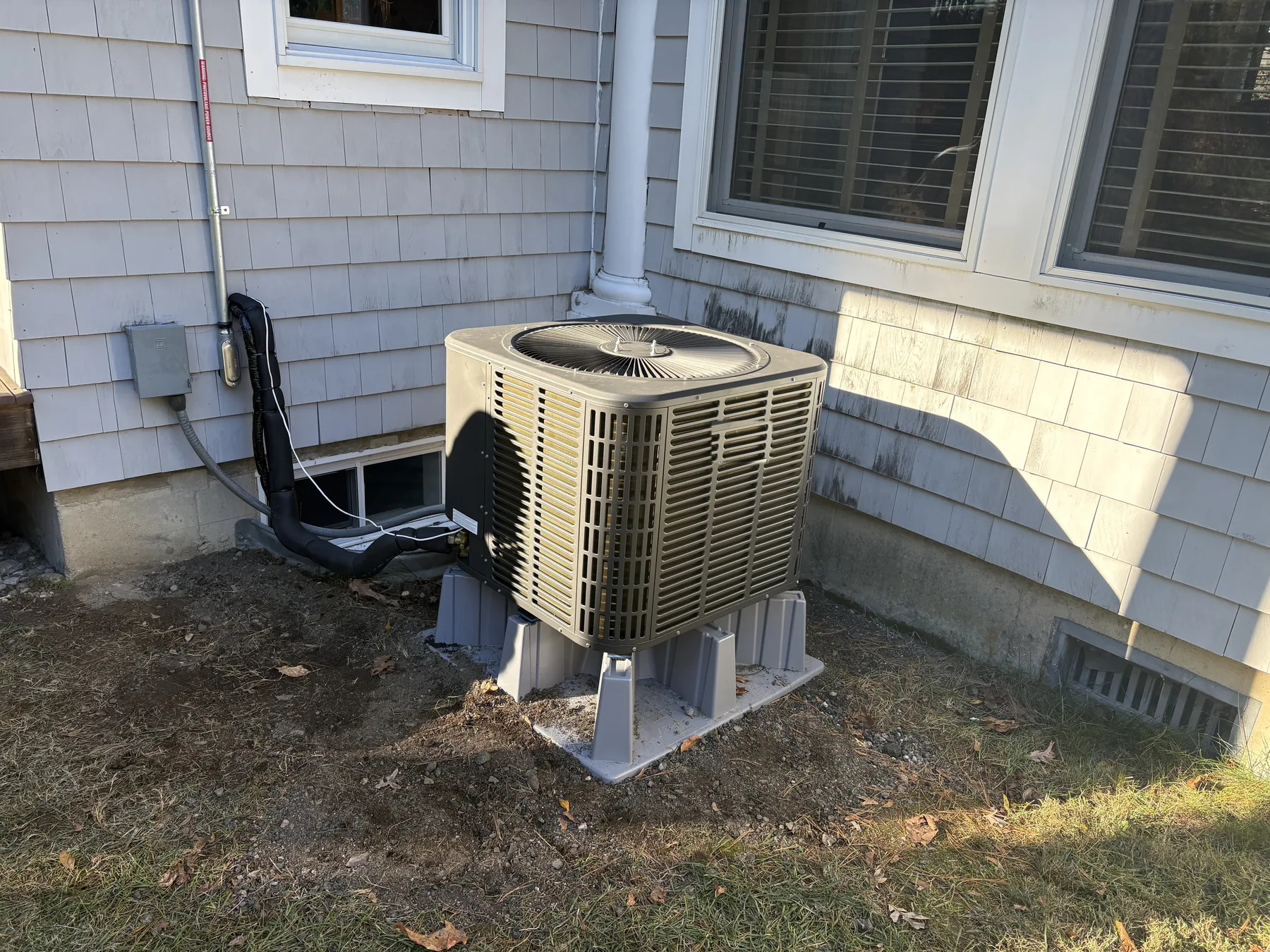
A heat-pump installation at a Hanson Home client site. Actual project photo supplied by Hanson Home.
Image credit / source: Hanson Home ↗An air conditioner moves heat from inside the home to outdoors. An air-source heat pump can reverse that process to provide heating as well as cooling. It uses electricity to run the compressor and fans while moving heat between indoors and outdoors; this is different from making all the heat with an electric resistance element.
Ducted systems distribute conditioned air through ducts. Ductless systems deliver it through indoor units serving individual rooms or zones. Either approach still needs an appropriate equipment selection and a way for conditioned air to reach the spaces you want to make comfortable. A heat pump is not limited to a wall-mounted mini-split.
Hanson Home’s recommendation is to choose the layout around the home: existing ducts and return paths, available wall or ceiling space, room use, appearance and the heating system you want to keep or replace. We can discuss equipment across brands once those requirements are clear.
Hanson Home recommendations for common Massachusetts projects
Here is how we recommend narrowing the choices before comparing brands. These are design recommendations for common situations; the final equipment selection needs the home’s load calculation and the proposed system’s performance data.
For primary winter heating, put heating capacity at the local design temperature ahead of the highest advertised cooling efficiency. A model with strong summer ratings can still need substantial backup heat. We recommend comparing a higher winter-performance option with a clearly planned backup arrangement, including the installed price and likely operating tradeoffs.
For a house with existing ducts, first establish whether the ducts can deliver the required airflow to the rooms that need it. If the distribution works, a compatible ducted heat pump can keep the interior familiar. If one floor or bedroom has poor airflow, include the duct correction or a separate zone in the comparison. Replacing the outdoor equipment alone may leave the original comfort problem.
For an addition, upstairs rooms or a home without ducts, compare the smallest useful single-zone, multi-zone and compact ducted layouts. We recommend checking minimum output and closed-door room coverage before deciding how many indoor units to buy. One large outdoor unit is not automatically the simplest solution to several small loads.
When budget is the priority, compare complete installed proposals and ask what a higher price actually buys. Our recommendation is to preserve appropriate sizing, drainage, electrical work and commissioning, then weigh equipment upgrades against their documented comfort and energy benefits. The operating-cost examples later in this guide show why an efficiency premium may or may not pay back.
Sources: ENERGY STAR: air-source heat-pump buying guidance, NEEP: sizing and selecting heat pumps in cold climates, NEEP: installing heat pumps in cold climates
A brief history: why the brands arrived at different strengths

Brand identification: TCL
Image credit / source: TCL North America ↗
Brand identification: Midea
Image credit / source: Midea Comfort ↗
Brand identification: Bosch
Image credit / source: Bosch Home Comfort ↗
Brand identification: Daikin
Image credit / source: Daikin Comfort Technologies ↗
Brand identification: Panasonic (Sanyo)
Image credit / source: Panasonic Holdings ↗
Brand identification: Mitsubishi Electric
Image credit / source: Mitsubishi Electric Trane HVAC US ↗
Brand identification: GENERAL
Image credit / source: GENERAL Inc. ↗
Brand identification: GREE
Image credit / source: GREE Comfort ↗
Brand identification: Carrier
Image credit / source: Carrier ↗
Brand identification: Samsung HVAC
Image credit / source: Samsung HVAC ↗The year a corporation was founded and the year it began making air conditioners are different facts. A long heating heritage, a room-AC manufacturing business and a US distribution partnership can all be useful—but each tells you something different. This timeline highlights milestones relevant to buying a system today, rather than awarding points for age.
| Brand / group | Relevant milestone | Consumer insight |
|---|---|---|
| Carrier [3] | Modern AC in 1902; company formed in 1915 | A long AC history; ductless sourcing still needs model-level review. |
| Daikin [4] | Founded 1924; packaged AC 1951; heat-pump packaged AC 1958 | Refrigeration and HVAC heritage spans both ducted and ductless equipment. |
| Mitsubishi Electric [5] | Founded 1921; specialized AC facility 1954; wall-mounted split 1968 | Decades of room-system development; current US support has a joint-venture structure. |
| Sanyo / Panasonic [6], [15] | Sanyo roots 1947; Panasonic AC business 1957; Sanyo fully acquired 2011 | Older Sanyo systems need legacy-model service checks. |
| GENERAL, formerly Fujitsu General [7], [20] | First window AC 1960; corporate name changed in 2026 | Older brand names can remain on products and paperwork during transition. |
| Midea [8] | Founded 1968; entered AC in 1985 | Its consumer logo sits alongside documented supplier and partnership roles. |
| Gree [9] | Founded 1991 with residential AC production | A dedicated AC manufacturing lineage; check each US product generation. |
| TCL [10] | Air-conditioner division established in 1999 | Its HVAC experience predates its recent North American retail expansion. |
| LG [24] | Residential AC roots in 1968 | Consumer electronics familiarity is only one part of its HVAC background. |
Who makes the equipment? Four relationships to understand
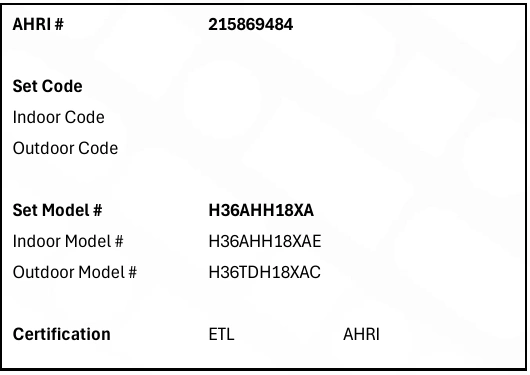
Excerpt from TCL’s published submittal: the AHRI reference and indoor/outdoor model fields. Ask your installer to verify the exact combination and its current certificate in the AHRI Directory.
Image credit / source: TCL North America ↗Brand ownership identifies the company controlling a name. An OEM manufactures equipment; a private brand marketer sells equipment under its own label. A joint venture combines defined businesses or capabilities. A component supplier might provide the compressor or fan without designing, assembling or warranting the complete system. Those relationships should not be collapsed into one claim that two brands are “the same.”
AHRI’s certification program accepts both OEMs and private brand marketers. Its matched-system records are useful for confirming a proposed combination, but a certificate is a performance record—not a complete map of factory ownership, firmware, service support or interchangeable parts.
Our practical interpretation: shared manufacturing can create good value, yet the purchase still includes the seller’s controls, distribution and warranty arrangements. Ask for written model-specific evidence when a salesperson claims two units are identical. Matching cabinet shapes, a common compressor brand or an online discussion is insufficient evidence of identical performance or replacement-part compatibility.
Midea: an established manufacturer with a less visible supplier role
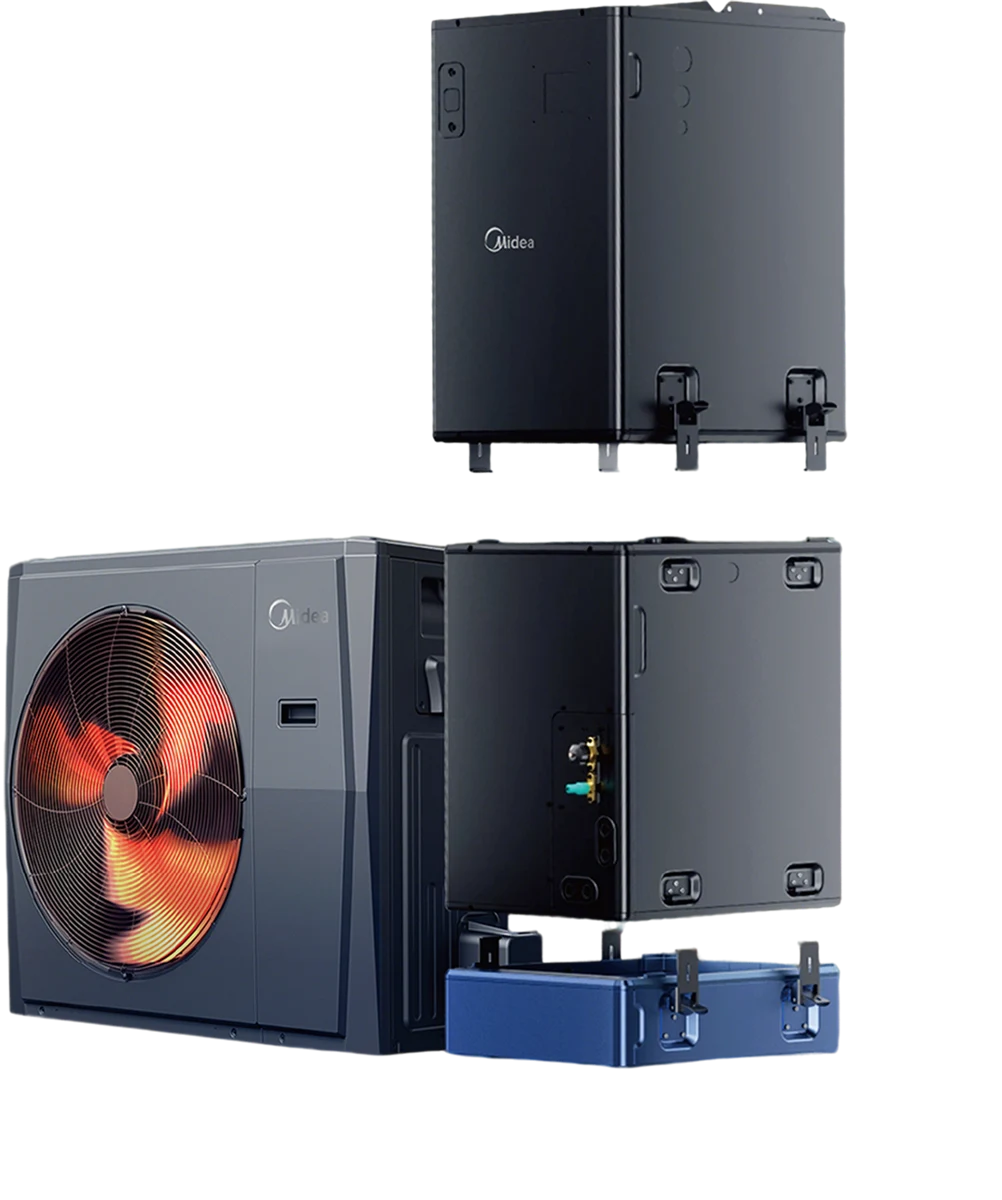
Midea EVOX G3 ducted-system image. Verify the exact indoor and outdoor models in the proposal.
Image credit / source: Midea Comfort ↗Midea dates its corporate roots to 1968 and its entry into air conditioning to 1985. Its Building Technologies division records a 1999 VRF milestone using Toshiba-Carrier technology, the 2015 Bosch VRF partnership and its 2016 acquisition of Clivet. These are specific business relationships, rather than evidence that every associated brand has the same residential equipment.
Carrier’s own North American ductless joint-venture announcement calls Midea a longstanding global supplier of residential ductless systems. That gives consumers a useful correction to brand familiarity: an unfamiliar retail name can belong to a company already participating behind better-known labels.
For a Midea quote, distinguish a room air conditioner from a professionally installed ducted or ductless system. Request the US product family, matched-system certificate, control package and local parts path. Our buying interpretation is that a direct Midea-branded offer is worth evaluating on its documents and installed scope; the supplier history alone cannot establish a reliability advantage or a particular price saving.
Sources: Midea: brand history, Midea Building Technologies: history and partnerships, Carrier: North American residential ductless partnership with Midea
Bosch and Midea: what the official partnership actually establishes
Bosch’s March 31, 2015 release announced a joint venture with Midea Commercial Air-Conditioner Division to manufacture variable refrigerant flow, or VRF, systems in Hefei, China. It described joint research and development, predominantly Bosch-branded distribution, commercial-building applications and a planned January 2016 production start. Midea’s own corporate history also records the 2015 Bosch VRF production joint venture.
This supports the statement that Midea and Bosch collaborated on Bosch-branded HVAC manufacturing. The cited release does not identify every US residential IDS model or establish that all Bosch heat pumps are simply relabeled Midea products. When evaluating an IDS quote, ask about that exact generation and combination rather than treating a commercial VRF announcement as a universal manufacturing map.
Sources: Bosch: Midea VRF joint-venture announcement, March 31, 2015, Midea Building Technologies: history and partnerships
Bosch today: inspect the IDS generation and the expanded brand family
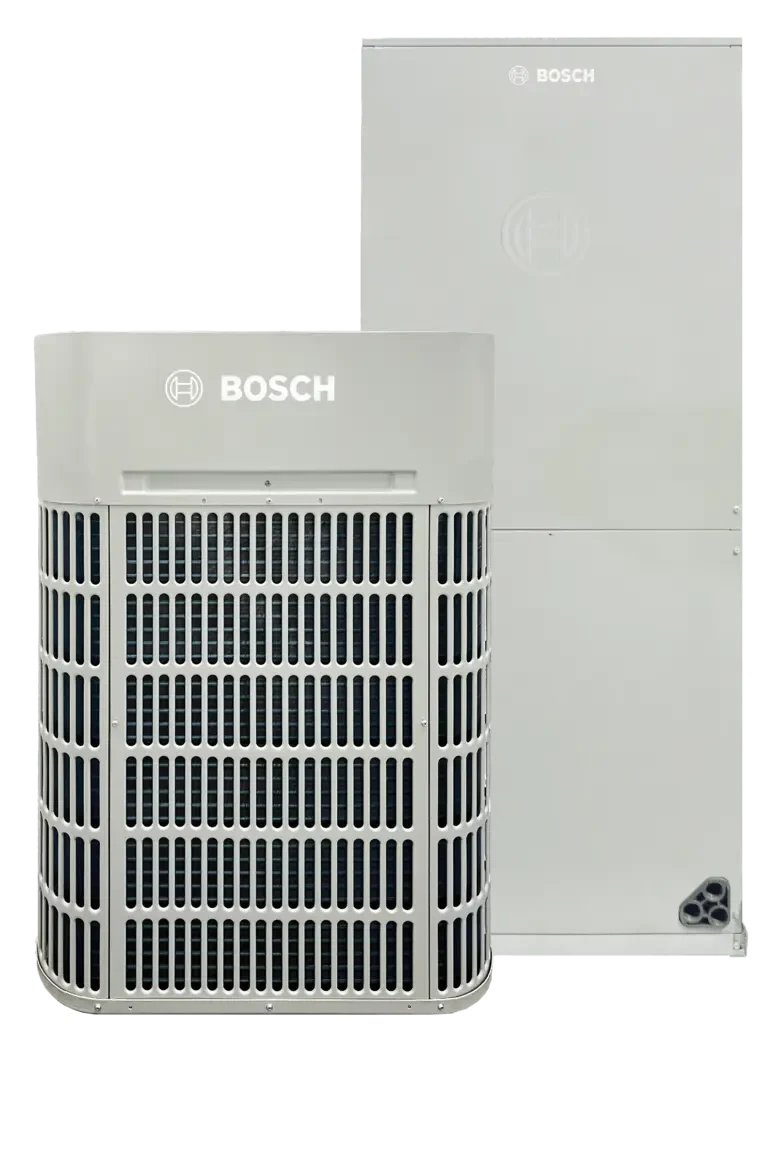
Bosch IDS Ultra outdoor unit and air handler. The illustrated family’s specifications should be checked for the selected combination.
Image credit / source: Bosch Home Comfort ↗Bosch’s HVAC business changed substantially when it completed the Johnson Controls residential/light commercial HVAC and Johnson Controls–Hitachi Air Conditioning transactions on July 31, 2025. Its release describes long-term licenses for YORK and Hitachi branding. That is a corporate portfolio change; it does not make a YORK system interchangeable with an existing Bosch IDS system.
On its IDS Ultra page, Bosch describes enhanced vapor injection and publishes up-to figures of 19 SEER2, 10 HSPF2 and 100% heating capacity at 5°F with COP 2.1. The page also distinguishes continued heating at lower temperatures. These are manufacturer claims for the Ultra family. They should not be applied to IDS Light or older IDS models.
Our buying interpretation: an IDS offer can be attractive for a ducted retrofit, but the family suffix matters. Compare its cold-weather output, approved air handler, duct airflow and thermostat instructions. An attractive price on a different IDS generation is not an equivalent substitute for a quoted cold-climate combination.
Sources: Bosch: completion of Johnson Controls / Hitachi HVAC acquisition, Bosch: IDS Ultra technical overview
Sanyo and Panasonic: a legacy name with a real HVAC lineage
Panasonic’s HVAC history includes Sanyo’s 1947 roots, alongside Panasonic’s own AC business launch in 1957 and first room cooler in 1958. Panasonic made Sanyo wholly owned in April 2011. A Panasonic-issued September 2011 release then announced that Sanyo’s North American HVAC group would be incorporated into Panasonic’s operations effective October 1, 2011.
For an owner of an older Sanyo mini-split, the relevant question is the service path for that particular installed system. Before approving a repair, ask whether its control board, sensors, fan motor and refrigerant-side components remain available, and compare the complete repair price with a properly designed replacement.
For a new purchase, ask which current US Panasonic model and distributor are actually being offered. Our interpretation: Sanyo is useful historical context and a legacy service issue, not a reason to assume a modern Panasonic indoor unit will connect to an old Sanyo outdoor unit. Require a manufacturer-approved match and current warranty terms.
Sources: Panasonic: HVAC business history, Panasonic: Sanyo becomes wholly owned, April 2011, Panasonic press release: Sanyo North American HVAC integration
Daikin, Goodman and Amana: global HVAC engineering meets US ducted distribution
Daikin traces its roots to 1924 and documents packaged air conditioning in 1951, heat-pump packaged equipment in 1958 and a commercial multi-split launch in 1982. Its 2012 purchase of Goodman expanded its North American residential ducted business. Daikin’s 2022 announcement describes the Texas manufacturing consolidation in 2017 and the subsidiary’s corporate rename to Daikin Comfort Technologies North America effective April 1, 2022.
Daikin’s announcement also retained product brands including Goodman and Amana. This makes a Daikin-versus-Goodman-or-Amana discussion more nuanced than comparing unrelated companies. Common ownership does not mean each product has the same compressor, efficiency, control logic or warranty. The useful comparison is the exact product tier and installed combination.
Daikin’s current comparison sheet identifies communicating models within its lineup. Our buying interpretation: consider the full indoor unit, outdoor unit and control package when comparing a communicating offer with a conventional thermostat offer. Ask what functions depend on the specified controller, what replacement controls cost and which contractor can diagnose the installed system.
Sources: Daikin: corporate chronology, Daikin: Goodman subsidiary name change, March 2022, Daikin: R-32 split-system heat-pump comparison, May 2026
Inside one brand: Daikin’s own tiers show why the model matters
Daikin’s May 2026 R-32 comparison sheet lists DH9VS with up to 21 SEER2 and 10 HSPF2, compared with DH7VS at up to 19 SEER2 and 8.8 HSPF2. Both are listed with variable-speed swing compressors and communicating controls; the sheet identifies DH9VS, but not DH7VS, as meeting the DOE Cold Climate Heat Pump Challenge.
The same sheet distinguishes variable-speed models from two-stage and other scroll-compressor models. These are design and product-tier differences inside one manufacturer’s lineup. The DOE Challenge is a particular performance program; its presence or absence does not, by itself, size the system for your house.
Our interpretation: a lower-cost model from a respected brand may be a sensible cooling or supplemental-heating choice, while a primary-heating project can justify a different tier. Ask for the selected combination’s low-temperature tables. Neither a corporate reputation nor an inverter label establishes equal winter capability across all tiers.
Sources: Daikin: R-32 split-system heat-pump comparison, May 2026
Mitsubishi Electric, Trane and American Standard: read the full label
Mitsubishi Electric’s history records a specialized AC facility in 1954 and its Kirigamine wall-mounted split launch in 1968. In the US, Mitsubishi Electric Trane HVAC US, or METUS, was established in 2018 as a 50/50 joint venture. Its listed brands include Mitsubishi Electric, Trane/Mitsubishi Electric and American Standard/Mitsubishi Electric.
The co-branded ductless offering should be identified separately from another Trane or American Standard product on a quote. The logo family does not establish that all central and ductless products share an architecture.
For a concrete example of why product generations matter, METUS’s April 2026 announcement for its five-ton SMART MULTI H2i outdoor unit states 100% heating capacity at 5°F, 80% at −13°F and a −24°F heating lockout. Those three numbers describe different things. They are not universal specifications for every Mitsubishi Electric unit.
Our buying interpretation: compare the proposed single-zone or multi-zone arrangement, minimum output, allowed indoor combinations and controls. A cold-climate feature name is a starting point; engineering data must show how the selected combination serves each room.
Sources: Mitsubishi Electric: air-conditioning history, Mitsubishi Electric Trane HVAC US: brands, ownership and warranty conditions, METUS: 2026 five-ton SMART MULTI H2i launch
Fujitsu General / GENERAL and Rheem: a name change buyers may encounter
The company now called GENERAL launched its first window AC in 1960. In August 2025, Fujitsu General announced that it had joined the Paloma Rheem group and noted a North American collaboration with Rheem dating to 2016, including product supply and joint development.
Effective January 1, 2026, Fujitsu General changed its corporate name to GENERAL Inc. The company says overseas FUJITSU branding will transition gradually, so a consumer may see different names across a product, brochure and corporate website.
Our buying interpretation: judge the exact US product and support documents rather than treating a renamed company as a newly invented manufacturer. Ask the dealer to identify the warranty issuer, the current registration process and the distributor responsible for parts. Group ownership does not make all Rheem and GENERAL products the same system.
Sources: GENERAL: company and air-conditioning history, Fujitsu General: joins Paloma Rheem group, August 22, 2025, GENERAL: January 1, 2026 corporate name change
Gree: substantial AC manufacturing, with important generation differences
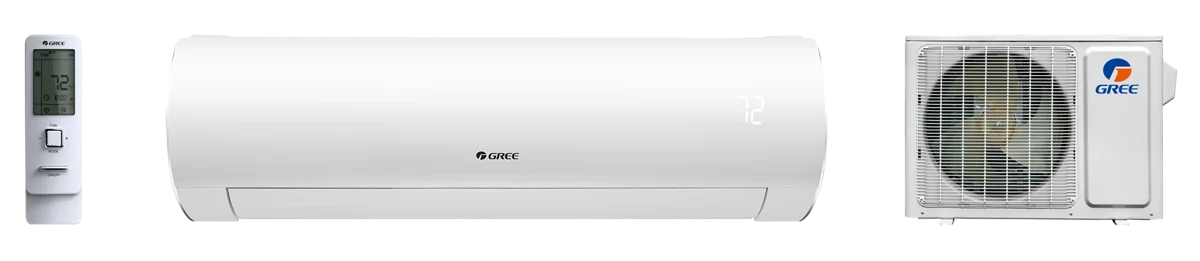
GREE Sapphire ductless-system image from the cited product page. Confirm the model generation and refrigerant offered.
Image credit / source: GREE Comfort ↗Gree’s corporate profile dates its establishment to 1991 and describes its early residential AC assembly and production. Its US Sapphire page illustrates a research trap: the page contains both SEER2/HSPF2 notation and older SEER/HSPF marketing, along with documents tied to specific model numbers. A shopper copying only the largest number can compare different rating systems or generations.
The Sapphire page lists a heating operating range extending to −22°F. An operating limit answers whether the equipment can run at a temperature. It does not, by itself, state the heat output, electrical input or share of your home’s load delivered there.
Our buying interpretation: a Gree system deserves the same model-level evaluation as other manufacturers. Ask for the submittal and extended ratings for the actual US combination, its refrigerant generation and the parts/warranty path through the proposed dealer. Confirm that online literature describes the equipment being installed.
Sources: Gree: corporate profile, Gree Comfort: Sapphire documents and performance claims
Carrier: historic AC leadership and a documented ductless supplier relationship
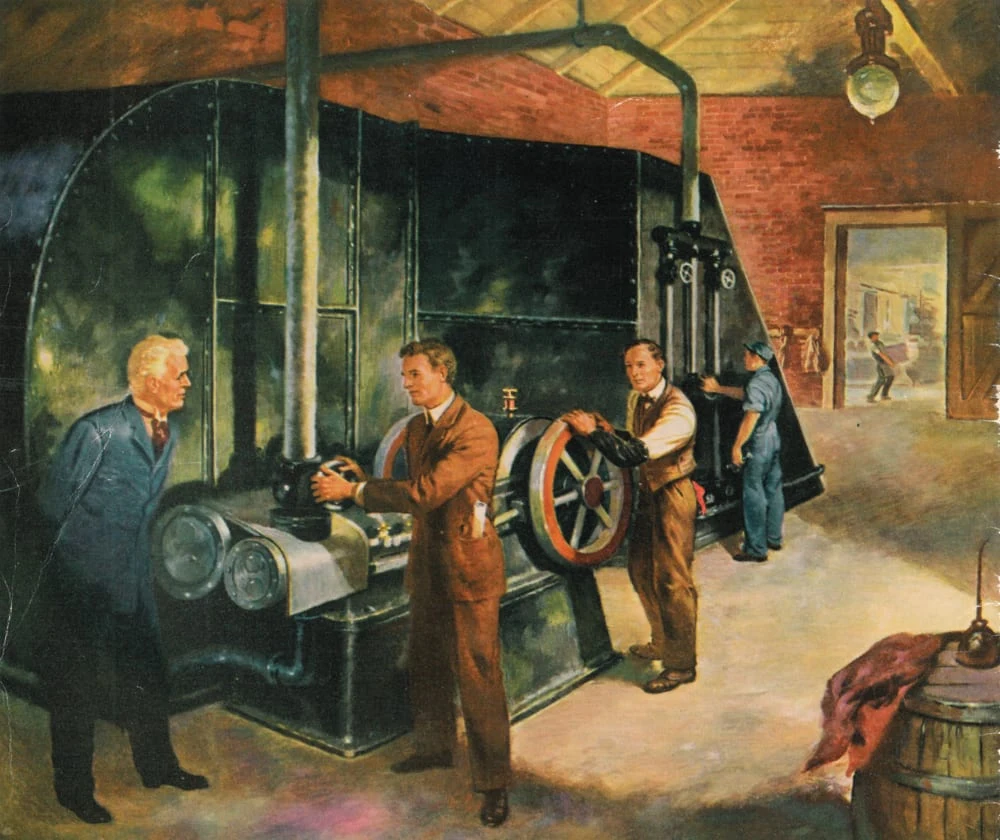
Carrier’s archive identifies this image with the 1902 Sackett & Wilhelms air-conditioning installation. It shows the industrial roots behind the modern brand.
Image credit / source: Carrier ↗Carrier connects its history to Willis Carrier’s 1902 modern air-conditioning system and the company’s formation in 1915. Its ductless joint-venture release explains a different part of the business: Carrier’s distribution network combined with Midea’s ductless development expertise, building on a longstanding supplier relationship.
Our buying interpretation: brand heritage can be useful when choosing a service channel, while the product family still determines the technical comparison. If a contractor offers Carrier central equipment and Carrier ductless equipment, request the documents and warranty terms for each. Neither a shared badge nor the Midea relationship establishes universal parts interchangeability.
Sources: Carrier: history of modern air conditioning, Carrier: North American residential ductless partnership with Midea
LG, Samsung and Lennox: comfort features plus changing distribution
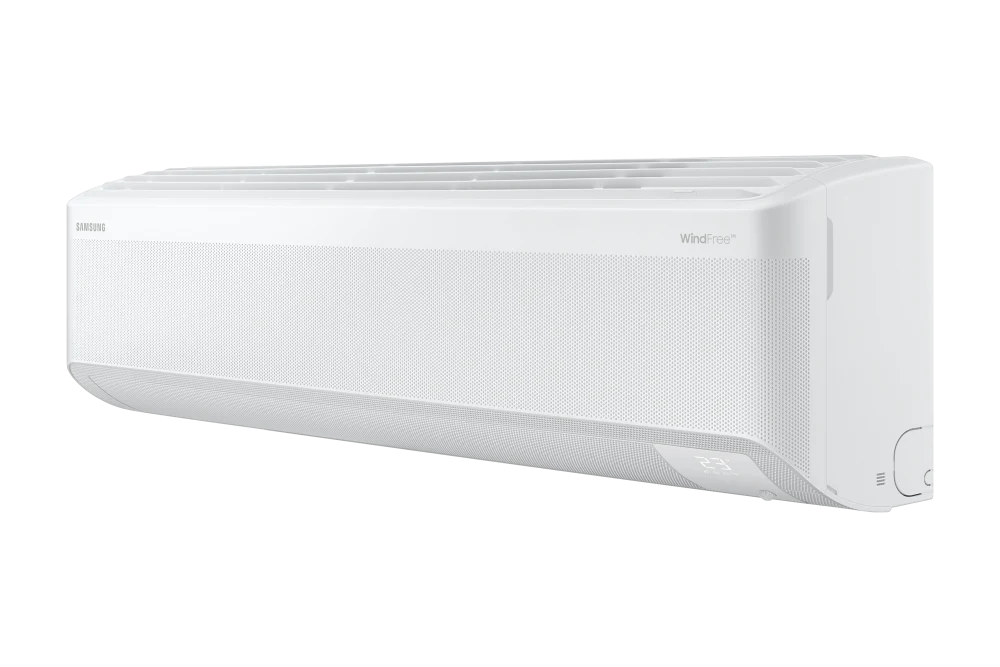
Samsung WindFree indoor-unit image from its Max Heat product page. Check the accompanying outdoor unit and room design.
Image credit / source: Samsung HVAC ↗LG dates its residential AC roots to 1968. Its current US residential page describes select LGRED models delivering 100% heating at 5°F and operating to −13°F, and lists several indoor unit styles. That combination can matter when appearance, ceiling space or airflow direction influences the design.
Samsung’s WindFree Max Heat page describes 100% heating performance at 5°F, an integral base-pan heater and dispersed cooling airflow through small openings. A quieter-feeling cooling airflow feature should be evaluated alongside the heating data and room coverage; it is not a replacement for those checks.
Lennox’s product-launch release confirms that Samsung Lennox HVAC North America was established in 2024 and introduced Lennox Powered by Samsung ductless and VRF offerings. Our buying interpretation: ask which distribution channel and warranty contract accompany a Samsung-branded versus co-branded proposal. Do not transfer a feature or specification from one product family to every Lennox system.
Sources: LG: history of its residential air-conditioning business, LG USA: residential HVAC systems and LGRED, Samsung HVAC: WindFree Max Heat, Lennox: Lennox Powered by Samsung product launch
TCL: its HVAC history is longer than many US shoppers realize
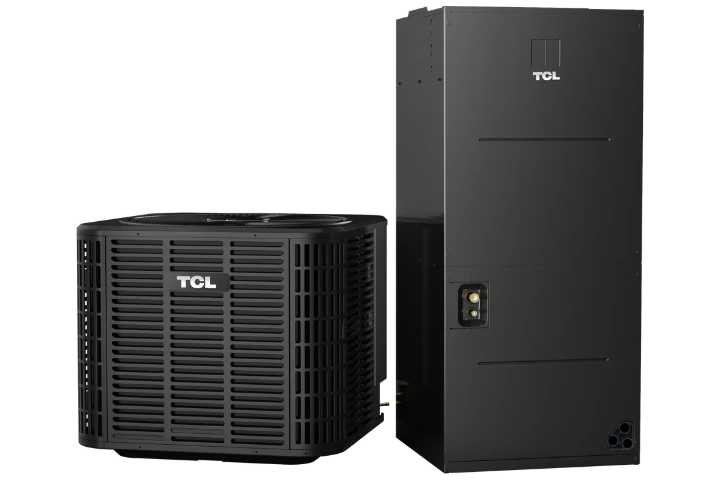
TCL Advantage product-family image. Match the proposed equipment to its own submittal and AHRI record.
Image credit / source: TCL North America ↗TCL’s North American HVAC history dates its air-conditioner division to 1999. Its current HVAC collection separates Advantage, Multi Match and other product families.
TCL is Hanson Home’s main brand, and we can also install other brands. We recommend evaluating a TCL proposal on the same concrete questions as a Bosch, Daikin or Mitsubishi Electric proposal: can the specified combination meet the load, does its control and indoor-unit layout suit the home, and is the installation and service scope clear?
A good TCL proposal should identify every indoor and outdoor model, the matched rating, the operating range, backup-heating plan if needed, electrical scope and included controls. If a quote refers only to “TCL inverter” or an efficiency maximum from another family, ask for the product-specific paperwork before deciding.
Sources: TCL North America: HVAC division history, TCL North America: HVAC product collection
TCL mini-splits at Home Depot
TCL Industries’ 2025 annual report says its Air Conditioner business entered North American retail channels, including Home Depot. Home Depot’s TCL mini-split category lists ductless systems, and some product listings are marked “Expert Installation Available.”
For homeowners comparing professionally installed systems, the retailer’s mini-split listings offer a concrete example of TCL’s retail range. The selected model and complete installation plan determine winter capacity, room coverage, controls and service.
Compare any retail equipment price with a contractor’s proposal only after matching the scope: system design, indoor units, electrical work, refrigerant piping, drainage, permits, commissioning and service coverage.
Sources: TCL Industries: 2025 annual report, pp. 31–32, Home Depot: TCL mini-split air conditioners
A TCL specification reading exercise: what “three ton” leaves out
TCL’s Advantage submittal for indoor H36AHH18XAE with outdoor H36TDH18XAC lists the figures below and identifies AHRI reference 215869484. This is a manufacturer-document example, not a claim that this is the right system for every house or that every current TCL model shares its ratings. Have the installer verify the current certificate and supplied model revisions.
| Measure | Published figure | How to use it |
|---|---|---|
| Seasonal cooling / heating | 19 SEER2 / 9 HSPF2-4 | Compare matching rating methods and complete combinations. |
| Cooling at 95°F | 34,000 BTU/h | Check against the cooling design load. |
| Heating at 47°F | 36,000 BTU/h; COP 3.2 | This warmer-weather point does not establish winter peak output. |
| Heating at 5°F | 26,000 BTU/h; COP 1.9 | Compare with the load at that temperature. |
| Outdoor heating range | −5°F to 80°F | An operating range is separate from a capacity guarantee. |
| Controls / refrigerant | 24VAC or TCL RS485; R-454B | Confirm the selected control configuration and approved components. |
Sources: TCL: Advantage H36AHH18XAE / H36TDH18XAC submittal, pp. 1–2
How Hanson Home would turn the TCL data into an installation decision
Consider an illustrative house that needs 32,000 BTU/h at 5°F. If the quoted system delivers 26,000 BTU/h at the same condition, the simple capacity difference is 6,000 BTU/h. The contractor must explain how the rest is supplied, whether by a different approved combination, additional equipment or planned backup. This is a worked example, not a heating assessment of a particular customer home.
Now consider a zone needing 22,000 BTU/h at the same condition. The same output might cover that zone’s load, subject to the manufacturer’s rating conditions, piping corrections, defrost behavior and actual distribution. The exercise demonstrates why our conclusion should be “check the fit,” rather than a blanket judgment about TCL.
This is the kind of comparison to request from Hanson Home for TCL or any other brand. Ask us to walk through the proposed model numbers, winter output and remaining load, then compare the installation options and backup plan. Review the equipment warranty, labor coverage, registration requirements and service contact alongside any duct, drainage or electrical work in the proposal.
Sources: TCL: Advantage H36AHH18XAE / H36TDH18XAC submittal, pp. 1–2
Cross-brand technical examples: what the published claims do—and do not—say
The examples below show how manufacturers describe current families or a particular combination. They are not a controlled head-to-head test. Sizes, indoor combinations and test conditions differ; family-level maxima may come from different configurations. Do not use this table as a price, reliability or efficiency ranking.
| Example | Manufacturer-published detail | Question for the installer |
|---|---|---|
| TCL Advantage H36 combination [30] | 26,000 BTU/h at 5°F; COP 1.9 | Does that output cover the calculated zone load? |
| Bosch IDS Ultra family [32] | Up to 100% capacity at 5°F / COP 2.1; up to 19 SEER2 and 10 HSPF2 | Which matched combination supplies those values? |
| Daikin DH7VS family [40] | Up to 19 SEER2 / 8.8 HSPF2; R-32 and communicating controls | What are this combination’s low-temperature output and minimum capacity? |
| Midea EVOX G3 family [31] | Published up to 19 SEER2, 10.8 HSPF2-4 and COP 2.14 at 5°F | Do the selected indoor/outdoor models achieve these same values? |
| Mitsubishi Electric 2026 five-ton SMART MULTI H2i [19] | 100% at 5°F; 80% at −13°F; lockout at −24°F | What output is available to the connected indoor units? |
| Select LGRED models [23] | 100% heating at 5°F; operation to −13°F | Which model, capacity and indoor match apply? |
| Samsung WindFree Max Heat [25] | 100% heating performance at 5°F; integral base-pan heater | What are capacity, input power and corrections at the design condition? |
SEER2, EER2, HSPF2 and COP answer different questions
SEER2 describes seasonal cooling efficiency; EER2 describes cooling efficiency at a specified rating condition; HSPF2 describes seasonal heating efficiency. DOE’s 2023 standards documentation uses the revised “2” metrics. Compare the same metric and rating basis. A brochure using older SEER/HSPF should not be placed in a numeric ranking against SEER2/HSPF2 without an appropriate conversion and equipment context.
COP, or coefficient of performance, compares delivered heat with electrical energy input at a given condition. Both quantities must use consistent units. A COP of 2 means two units of heat delivered per unit of electricity consumed. COP is useful for a cold-weather point; it is not an annual bill forecast.
When reviewing specifications, ask whether a capacity/COP point is rated, minimum-speed or maximum-speed operation. NEEP’s sizing tools compare equipment output and building loads. A high seasonal score and a strong maximum-capacity point can coexist with different performance at the temperatures and speeds your home actually uses.
Our buying approach: keep two columns in your comparison—seasonal metrics and winter design-point data. A cooling-focused buyer may give SEER2 more weight; a household relying on the equipment for winter heating needs the low-temperature capacity, input power and backup plan alongside HSPF2.
Sources: DOE: 2023 central AC and heat-pump standards FAQ, NEEP: cold-climate sizing support tools
Cold-weather capacity, vapor injection and the balance point
As outdoor conditions change, the home’s heating demand and the heat pump’s available output change. NEEP’s selection guidance calls for manufacturer performance near the outdoor design condition. The temperature at which available heat matches the home’s load is often called the thermal balance point; below it, a capacity shortfall must be addressed by the system design.
Bosch describes enhanced vapor injection in IDS Ultra; METUS describes flash injection in its 2026 SMART MULTI announcement. These approaches support low-temperature compressor performance. Their presence is not enough to size equipment: the final output and input-power tables remain the evidence that matters.
Our interpretation for Massachusetts buyers: “heats down to −22°F” and “delivers the calculated heating load at −22°F” are separate promises. Ask for the documented outdoor design temperature for your location, the indoor design temperature, load at that condition and available delivered output. Coastal and inland locations should not automatically receive the same weather assumption.
Also ask how the design accounts for defrost and backup operation. A family’s advertised lowest operating temperature should not be treated as proof of complete-house coverage, zero auxiliary heat or low operating cost.
Sources: NEEP: sizing and selecting heat pumps in cold climates, Bosch: IDS Ultra technical overview, METUS: 2026 five-ton SMART MULTI H2i launch
Minimum output and zoning: the specification buyers often miss
An inverter compressor can vary output, but it still has a minimum stable capacity. NEEP identifies minimum capacity as an important selection criterion and warns against choosing multi-zone equipment only by the desired number of rooms. Oversizing can leave too much output available when the home needs little heat or cooling.
Our illustrative example: a small bedroom needs 2,000 BTU/h on a mild day, while a proposed outdoor system cannot operate steadily below 8,000 BTU/h under that condition. A large maximum capacity does not solve the mismatch. Ask how the design handles a call from that bedroom alone and how other indoor units behave.
Compare three layouts before assuming one large outdoor unit is best: several single-zone systems; a smaller multi-zone system; and a compact ducted unit serving several small rooms. Evaluate outdoor space, piping, indoor appearance, minimum output, service access and what remains available during a repair.
For summer comfort, ask about minimum cooling output and humidity control as well. A system that reaches the thermostat setting quickly is not necessarily providing the most comfortable moisture removal. A room-by-room heat-load and cooling-load review makes the discussion much more concrete.
Sources: NEEP: sizing and selecting heat pumps in cold climates, Bosch: R-454B air-to-air product FAQs
Ducts and controls can change the result across brands
For a ducted retrofit, ask the contractor to evaluate airflow and external static pressure—the resistance the blower works against. A new outdoor unit cannot correct inadequate return paths or every existing duct problem. Bosch’s FAQs specifically connect comfort problems with sizing, duct layout, static pressure and control setup.
Control approaches also differ. Bosch says IDS Light does not require a communicating thermostat and works with most 24VAC thermostats. Midea’s EVOX G3 page describes both 24V and 485 compatibility; TCL’s cited Advantage combination lists 24VAC and TCL RS485 control options. Daikin’s comparison sheet identifies communicating models. These examples are model-specific, not universal rules for their brands.
Our comparison questions: Will the existing thermostat work? Will retaining it change available functions? Which controller regulates indoor fan speed and auxiliary heat? Can the homeowner operate the system if Wi-Fi is unavailable? Is remote temperature sensing included? What control and sensor replacements would cost should be part of the discussion.
Have the quote name the exact thermostat, interfaces and backup control sequence. For a multi-zone layout, ask what happens when one room wants heating while another wants cooling; do not assume independent temperature settings mean unrestricted simultaneous modes.
Sources: Bosch: R-454B air-to-air product FAQs, Midea Comfort: EVOX G3 specifications, TCL: Advantage H36AHH18XAE / H36TDH18XAC submittal, pp. 1–2, Daikin: R-32 split-system heat-pump comparison, May 2026
R-32 versus R-454B: what a consumer should compare
EPA lists R-32 and R-454B as A2L refrigerants subject to use conditions. On EPA’s Technology Transitions reference basis, their global warming potentials are 675 and 465 respectively, compared with 2,088 for R-410A. Keep the reference basis consistent: another document may quote slightly different values based on a different assessment.
A2L is a safety classification, not an efficiency score. Equipment and installation must be designed for the specified refrigerant. A lower GWP does not automatically produce a higher COP, quieter unit or lower bill; those depend on the complete system and operating conditions.
Our buying approach: ask what refrigerant the quoted equipment uses, which installation safeguards the manual requires, and whether the contractor is trained and equipped to service it. Compare service availability and approved components alongside environmental impact. Do not assume a different refrigerant can be added to an existing system as a simple upgrade.
Sources: EPA SNAP: residential AC / heat-pump refrigerant alternatives, EPA: Technology Transitions GWP reference table
Operating cost: two calculations more useful than a brand slogan
The following examples use an assumed electricity price of $0.30/kWh. It is not a current Massachusetts tariff. Use your own bill’s applicable electricity charges and recognize that fixed charges may not change with heating use. These are simplified arithmetic examples, not seasonal savings estimates.
Heating example: suppose the system must deliver 30,000 BTU/h. Using 3,412 BTU per kWh, that is about 8.79 kW of delivered heat. At COP 3, electrical input is about 2.93 kW, costing $0.88 per hour. At COP 2, input is about 4.40 kW, costing $1.32 per hour. At COP 1, resistance heating delivering the same heat costs about $2.64 per hour. Runtime, changing loads, defrost and auxiliaries will alter real totals.
Cooling example: under identical seasonal load and rating assumptions, changing from 16 SEER2 to 20 SEER2 implies roughly 16 ÷ 20 = 0.80 of the cooling electricity, or a 20% reduction in that simplified comparison. If the annual cooling electricity would otherwise cost $500, the illustration is about $100 per year. It is not a prediction of a specific home’s bill.
Our buying interpretation: compare the price premium with realistic heating and cooling savings, maintenance and service terms. If a more efficient option costs $2,000 extra and plausibly saves $100 annually, a simple energy-only payback would be 20 years. Comfort improvements, financing, maintenance and future rates may change the decision, but should be stated separately.
Warranty, parts and commissioning: compare what happens after the sale
A warranty headline is only the beginning. METUS notes that installation by a Diamond Contractor and registration within 90 days affect access to its best residential terms. Bosch’s IDS Ultra page separates the parts protection from a shorter term for gateway connectivity components. These examples show why the written contract and specific covered component matter.
Our service questions: Are labor, travel, diagnostics, refrigerant and shipping covered? Who submits the claim? Is registration required, and who completes it? Are there owner, application or installation conditions? Which distributor supplies boards and motors? Can another local contractor service the system if the original installer is unavailable?
NEEP’s installation guide addresses siting, snow and water management, refrigerant work and startup checks. Ask for a commissioning record appropriate to the model: leak/pressure testing, evacuation and charge verification, electrical checks, heating/cooling startup, controls and drainage checks, and airflow/static-pressure checks for ducted systems.
Keep the model/serial list, matched-system certificate, manuals, registration confirmation and commissioning record together. Our interpretation: documented installation and a workable repair path are purchase value. A larger equipment discount may not compensate for an unclear service agreement when heat is needed.
Sources: Mitsubishi Electric Trane HVAC US: brands, ownership and warranty conditions, Bosch: IDS Ultra technical overview, NEEP: installing heat pumps in cold climates
Build a shortlist with Hanson Home around your home’s needs
Hanson Home can help you compare and install equipment across brands. The table below is our framework for deciding which configurations deserve closer investigation. It is not a universal brand ranking: each shortlisted combination still needs appropriate capacity, a complete installation scope and a workable service plan.
| Your priority | Candidates / configurations to investigate | Evidence to request |
|---|---|---|
| Reuse existing ducts | Documented ducted offers from TCL, Bosch, Midea, Daikin/Goodman, Carrier or another supported supplier | Duct airflow/static pressure, compatible indoor match, design-point heating, controls and backup sequence. |
| Heat individual rooms without ducts | Single-zone and multi-zone options from TCL, Mitsubishi Electric, GENERAL, Daikin, Gree, LG, Samsung or Carrier | Room loads, minimum capacity, closed-door coverage, indoor placement and connected-unit corrections. |
| Depend on it for primary winter heat | A verified cold-climate combination from any candidate brand | Capacity and input at the local design temperature; defrost, outage and backup planning. |
| Spend less while retaining dependable service | Compare equivalent scope across several supported brands | Complete installed price, documented sizing, warranty/labor terms and a named parts/service path. |
| Resolve an older Sanyo repair decision | Legacy-model repair versus a current approved replacement system | Actual parts availability, total repair price, remaining system condition and replacement design. |
Copy this scorecard into your quote request
Ask every bidder to complete the same fields. A useful proposal makes these answers reviewable before purchase; missing data is a reason to clarify the offer. Avoid scoring a manufacturer by a best-case brochure number while another bidder quotes the actual combination.
- Job: cooling only, partial heating or complete heating replacement; ducts and zones served.
- Loads: heating/cooling calculation, design temperatures and room loads where applicable.
- Equipment: every indoor/outdoor model, refrigerant generation and matched-system reference.
- Winter: capacity and input power at the design condition, with applicable corrections and backup requirements.
- Part load: minimum heating/cooling capacity and behavior when only the smallest zone calls.
- Controls: thermostat/controller models, sensors, Wi-Fi independence and backup sequence.
- Installation: ducts, electrical supply, piping, drainage, siting, permits and commissioning scope.
- Service: written parts/labor coverage, registration responsibility, claims contact and local parts supplier.
- Price: complete installed total and clearly itemized alternatives; compare the same scope.
- Decision: document which option meets the loads, comfort priorities, service expectations and budget.
What to discuss with Hanson Home before choosing equipment
Start with the comfort problem. Tell us which rooms are too cold or too hot, whether doors usually stay closed, how you use each floor and what you want to retain from the existing heating system. Share any model numbers or quotes you already have. These details make a brand comparison more useful than a list of efficiency scores.
Ask us to explain the choices in plain language: why a ducted or ductless layout fits, how the proposed equipment covers winter demand, what happens during defrost or backup operation, and which controls you will use every day. For summer cooling, include airflow, noise, humidity and indoor-unit placement in the discussion.
Finish by comparing the complete project: equipment, electrical and duct work, piping, drainage, permits, commissioning, warranty and service terms. A useful recommendation should make the tradeoffs visible so you can decide what is worth paying for. Hanson Home can work with your preferred brand and help you evaluate other options that fit the same goals.